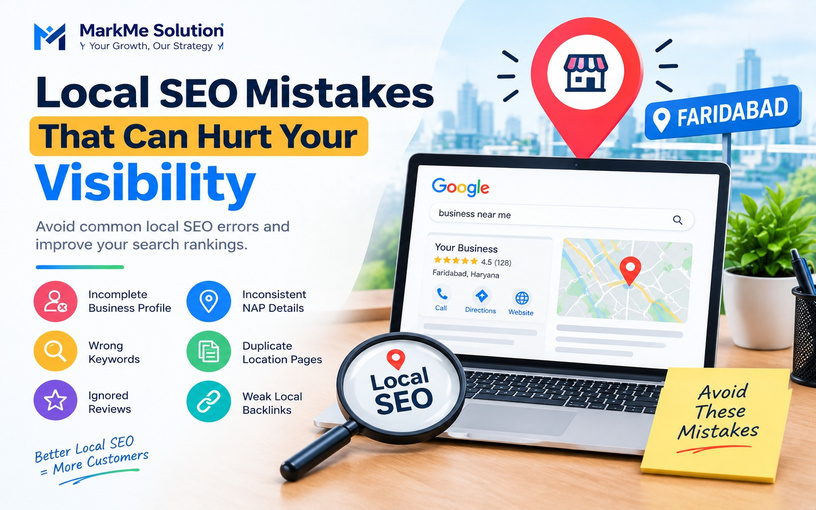
Local SEO InsightsSearch Visibility & Business Growth
Local SEO plays a crucial role in helping businesses appear when nearby customers search for products or services on Google. Whether you run a digital marketing agency, a retail store, a clinic, or a home service business, strong local search visibility can help you attract relevant visitors, generate inquiries, and build trust within your service area.
However, many businesses struggle to achieve consistent local SEO results because of avoidable mistakes. An incomplete Google Business Profile, inconsistent business information, poorly optimized location pages, or low-quality backlinks can weaken your local search strategy.
The good news is that most local SEO problems can be identified and improved with the right approach.
In this guide, we will explore the most common local SEO mistakes that can hurt your visibility, explain why they matter, and provide practical solutions to help your business build a stronger local presence.
GOOGLE BUSINESS PROFILE
1. Incomplete or Incorrect Google Business Profile Information
Your Google Business Profile helps customers discover important information about your business in Google Search and Maps. Missing or inaccurate details can confuse potential customers and reduce the usefulness of your listing.
Common mistakes include:
Choosing an irrelevant primary business category.
Leaving business hours outdated.
Using an incorrect phone number or website URL.
Adding an incomplete business description.
Failing to list relevant services.
Ignoring customer questions and reviews.
How to fix it:
Complete your profile using accurate, up-to-date business information. Select the most appropriate primary category, add relevant secondary categories where applicable, list your genuine services, and update your hours whenever they change.
Avoid adding unnecessary keywords to your business name. Your profile name should reflect your actual real-world business name and follow Google's guidelines.
BUSINESS INFORMATION CONSISTENCY
2. Inconsistent Name, Address, and Phone Number (NAP)
Search engines and customers need consistent business information to identify and contact your business. Differences in your business name, address, or phone number across directories can create confusion, especially when the information is outdated or refers to a different business.
For example, your website may list one phone number while an old directory displays another.
02 How to fix it:
Establish the correct business name, address, and phone number.
Update important business directories and industry listings.
Correct outdated contact details on your website.
Remove or correct duplicate listings where appropriate.
Review important citations periodically.
Consistency is a useful local SEO best practice, but minor formatting differences do not automatically cause ranking penalties. Focus on accurate, trustworthy information.
LOCAL KEYWORD STRATEGY
3. Targeting the Wrong Local Keywords
Choosing keywords without understanding search intent can attract visitors who are unlikely to become customers.
For example, a business serving Faridabad may target a broad term such as “SEO services” without creating relevant content for people looking specifically for an SEO agency in Faridabad.
Local search terms often include a service, location, or proximity-based phrase.
Research relevant keywords based on your services, actual service areas, customer needs, and competition. Assign related keywords to the most appropriate pages instead of creating multiple pages with nearly identical content.
Use local keywords naturally in page titles, headings, service descriptions, and useful website content. Avoid keyword stuffing, which makes content harder to read and can violate Google's spam policies.
LOCATION PAGE OPTIMIZATION
4. Creating Poor-Quality or Duplicate Location Pages
Businesses sometimes create dozens of location pages by replacing one city name with another while keeping nearly identical content.
For example, a website might publish separate pages for Faridabad, Gurgaon, and Noida without providing any meaningful location-specific information.
These pages offer little additional value and may be considered doorway abuse when they are primarily designed to funnel visitors to the same destination.
How to fix it:
Create location pages only when they serve a genuine customer need. Include useful, accurate information about the services available in that area, relevant customer requirements, service coverage, and practical next steps.
If your business serves Faridabad and nearby cities, explain the actual coverage clearly rather than claiming a physical office in every location.
CUSTOMER TRUST & REVIEWS
5. Ignoring Customer Reviews and Ratings
Customer reviews influence how potential customers evaluate a business. A profile with unanswered feedback or unresolved customer concerns may appear less trustworthy to people comparing local providers.
Reviews can also provide useful feedback about customer expectations and service quality.
How to fix it:
Ask genuine customers to leave honest reviews.
Respond professionally to positive and negative feedback.
Address legitimate concerns where possible.
Make the review process simple without pressuring customers.
Avoid buying reviews or offering incentives in exchange for positive reviews.
Review quantity, quality, and ratings can contribute to local prominence, but businesses should never assume that reviews alone determine rankings.
ON-PAGE SEO OPTIMIZATION
6. Neglecting On-Page Local SEO
Your Google Business Profile is only one part of local search optimization. Your website also needs clear information about the services you provide and the areas you serve.
Common on-page local SEO mistakes include missing location information, generic service pages, weak title tags, unclear headings, and insufficient contact details.
How to fix it: Optimize important pages by including:
Descriptive page titles and headings.
Clear service descriptions.
Relevant location information.
Accurate business contact details.
Useful internal links.
Appropriate images and descriptive alt text.
Clear calls to action.
For example, a page titled “SEO Services in Faridabad” should explain the SEO services offered, who they help, and how potential customers can get in touch.
The content should be written for users first, with keywords included naturally.
WEBSITE SPEED & MOBILE EXPERIENCE
7. Having a Slow or Mobile-Unfriendly Website
Many local searches happen on mobile devices. If your website loads slowly, displays incorrectly, or makes it difficult to call your business, visitors may leave before contacting you.
A poor mobile experience can reduce engagement and conversions even when your listing attracts relevant visitors.
How to fix it:
Use a responsive website design.
Compress and properly size images.
Reduce unnecessary scripts and resources.
Make phone numbers easy to tap.
Keep forms short and usable.
Ensure text and buttons are readable on smaller screens.
Test important pages using PageSpeed Insights and real mobile devices.
Core Web Vitals and overall page experience are worth monitoring, but a fast website alone does not guarantee higher local rankings. It should be part of a broader optimization strategy.
LOCAL AUTHORITY & BACKLINKS
8. Failing to Build Relevant Local Authority
Local SEO is not just about adding a city name to your website. Google considers relevance, distance, and prominence when determining local results.
Businesses can weaken their local presence by neglecting genuine industry relationships, relevant local mentions, and credible references to their work.
How to fix it: Build authority through legitimate activities such as:
Participating in relevant local business associations.
Earning mentions from reputable local publications.
Collaborating with complementary businesses.
Publishing useful industry resources.
Maintaining accurate profiles on relevant directories.
Earning editorial backlinks from relevant websites.
Avoid automated link schemes, mass directory submissions, and paid links intended to manipulate rankings. Relevant, trustworthy references are more valuable than a large number of low-quality links.
BUSINESS CATEGORIES & SERVICE AREAS
9. Using Incorrect Business Categories or Misleading Service Areas
Choosing the wrong Google Business Profile category can make it harder for Google to understand what your business offers. Misrepresenting your location or service area can also create trust and eligibility problems.
For example, a service-area business should not create fake offices in cities where it has no eligible business location.
How to fix it:
Select the most accurate primary category for your core business, add relevant secondary categories where appropriate, and configure service areas according to Google's rules.
If you serve customers in Faridabad and nearby areas, reflect those service areas accurately. Do not add city names to your business name simply to influence rankings.
LOCAL SEO PERFORMANCE TRACKING
10. Ignoring Local SEO Performance Data
Without measurement, it is difficult to determine whether your local SEO activities are working.
Some businesses focus only on keyword rankings while overlooking important indicators such as customer inquiries, calls, website clicks, and direction requests.
How to fix it: Use Google Search Console, website analytics, and Google Business Profile performance data where available to monitor relevant metrics.
Track:
Search impressions and organic clicks.
Queries that generate website visits.
Performance of important local landing pages.
Calls, forms, and qualified inquiries.
Business Profile interactions.
Changes after significant SEO improvements.
Review performance over time rather than reacting to short-term ranking fluctuations. Local results can differ by searcher location, device, and search context.
STRUCTURED DATA & WEBSITE ARCHITECTURE
11. Overlooking Local Business Schema and Website Structure
Structured data can help search engines understand information about your business. Poor implementation, missing relevant information, or incorrect markup can limit its usefulness.
How to fix it:
Where appropriate, implement accurate LocalBusiness or relevant subtype structured data on your website. Include supported, truthful information that matches the visible content on the page.
Validate your markup using Google's Rich Results Test and Schema Markup Validator. Remember that structured data does not guarantee rich results or improved rankings, and adding schema does not replace a well-structured website.
LOCAL CONTENT MARKETING
12. Publishing Content Without Answering Local Customer Questions
Publishing frequent blog posts does not automatically improve local SEO. Content that repeats the same keywords without offering useful information may fail to satisfy visitors.
Local customers often want clear answers about services, availability, pricing factors, service coverage, and how to contact a business.
How to fix it: Develop content around genuine customer questions and local needs.
For example, a Faridabad SEO agency could publish:
How to Choose the Best SEO Agency in Faridabad.
How Much Do SEO Services Cost in Faridabad?
Local SEO Strategies for Small Businesses.
How to Improve Your Google Business Profile.
Common Website SEO Problems and How to Fix Them.
Link relevant blog posts to the appropriate service pages so readers can move naturally from learning about a problem to exploring a solution.
MARKME SOLUTION SEO SERVICES
How MarkMe Solution Can Help Improve Local SEO
MarkMe Solution helps businesses strengthen their online presence through SEO and digital marketing services. For businesses targeting Faridabad and nearby areas, a suitable local SEO strategy may include Google Business Profile optimization, local keyword research, technical SEO, on-page optimization, location-specific content, internal linking, and performance monitoring.
The first step is to identify the issues affecting your current visibility and prioritize improvements according to their relevance and potential business value.
Instead of applying the same checklist to every website, an effective strategy considers your industry, competition, service areas, website condition, and customer acquisition goals.
LOCAL SEO AUDIT
Local SEO Audit Checklist
Use this checklist to review your current local SEO setup.
Google Business Profile information is accurate and complete.
Business categories match the services offered.
Phone number, address, and website details are correct.
Relevant local keywords are mapped to appropriate pages.
Important service and location pages provide useful content.
Genuine customer reviews are encouraged and answered professionally.
Website pages work properly on mobile devices.
Technical SEO and indexation issues are monitored.
Local mentions and backlinks are earned through legitimate methods.
Website traffic, inquiries, and profile performance are measured.
Review these points regularly and prioritize the issues most likely to affect customers or prevent search engines from accessing your content.
FINAL THOUGHTS
Final Thoughts
Local SEO is an ongoing process that requires accurate business information, useful website content, a strong customer experience, and consistent performance monitoring. Small mistakes can create confusion for customers or prevent your website and business profile from communicating your value effectively.
By correcting these issues, businesses can build a stronger foundation for local visibility and customer acquisition.
Want to improve your local search presence? MarkMe Solution can help you identify local SEO opportunities and develop a practical strategy for your business goals.
Want to improve your local search presence?
MarkMe Solution can help you identify local SEO opportunities and develop a practical strategy for your business goals.
Get answers to common questions about local SEO mistakes and improving your business visibility.
1. What are the most common local SEO mistakes?
Common mistakes include incomplete business profiles, inaccurate contact information, keyword stuffing, duplicate location pages, ignored reviews, weak local landing pages, and failure to monitor performance.
2. How does Google Business Profile affect local SEO?
A well-maintained Google Business Profile helps Google understand your business and gives customers useful information. Local rankings are influenced by relevance, distance, and prominence, so profile optimization is only one part of the overall strategy.
3. How long does it take to improve local SEO?
The timeline depends on competition, current website condition, profile quality, and the changes implemented. Some corrections can improve the customer experience quickly, while meaningful visibility improvements may take several months.
4. Do customer reviews improve local rankings?
Reviews can contribute to prominence and help customers evaluate a business. Encourage genuine feedback and respond professionally, but do not buy reviews or expect a particular number of reviews to guarantee a ranking.
5. Should I create separate pages for every city I serve?
Only create separate location pages when they provide useful, genuinely relevant information for customers in those areas. Avoid producing near-identical pages solely to target multiple city names.
6. Can local SEO generate more leads?
Local SEO can help relevant customers discover your business through search and Maps. Actual leads depend on factors such as your services, reputation, pricing, website experience, competition, and how easily customers can contact you.